
“As a father of an autistic child in Nagaland, I do not experience autism as a ‘day of awareness’, I experience it as a daily negotiation with a system that is not built for my child.”
Every year on April 2, the world observes World Autism Awareness Day. Social media turns blue. Institutions speak of inclusion, acceptance, and understanding. But for many families in Nagaland raising children with autism and other intellectual and developmental disabilities (IDD), this “awareness” feels detached from reality. Because behind the messaging lies a truth we rarely
confront: our society still does not know how to include these children and too often chooses not to try.
The stigma we pretend does not exist.
Autism in Nagaland remains poorly understood. When a child does not speak like others, avoids eye contact, or behaves differently, the first response is rarely empathy. It is suspicion, judgment, or blame. Parents are questioned. Parenting is blamed. Some turn to spiritual explanations. Others prescribe discipline as a “solution.” What is missing is basic understanding: autism is a neurological condition, not a behavioural failure, not a parenting defect. Because of this ignorance, many families withdraw, not out of shame, but exhaustion. Constantly explaining, defending, and justifying a child’s existence takes a toll.
The Silence within Families.
Not all exclusion comes from institutions. Some of it begins at home. There are parents in our society who struggle to accept that their child is autistic or neurodivergent. Some avoid conversations when asked about their child. Some offer explanations to normalise the situation. Others withdraw entirely, choosing silence over engagement. Many hold on to the hope that the child will “outgrow” the condition. But autism is not a phase. It is not something a child simply grows out of. And denial, however understandable, comes at a cost. When a child is hidden from society, denied early intervention, or kept away from opportunities to learn and interact, the consequences are long-term and often irreversible. Critical developmental windows are missed. Communication skills are delayed. Social confidence is eroded before it even has a chance to form. In trying to protect the child from stigma, we unintentionally deny the child their right to grow, to learn, and to become who they are capable of being. This is not about blaming parents. The reality is more complex. Many families are navigating fear—fear of judgment, social stigma, and an unforgiving environment. In a society where difference is poorly understood, silence often feels like the safer option. But silence does not solve the problem. It deepens it. What these families need is not criticism, but awareness, acceptance, and support—within the family, within the community, and within the wider society. And this is where Nagaland still falls short. We pride ourselves on being a close-knit, community-oriented society. Yet when it comes to neurodivergent children, that sense of community often fails to translate into understanding or support. Until families feel safe to
acknowledge their children without fear of judgment, and until communities respond with empathy rather than stigma, meaningful inclusion will remain out of reach. Because inclusion does not begin in policy or institutions. It begins with acceptance—at home, and in society.
The Annual Humiliation: School Admissions.
For most families, the academic year begins with hope. For parents of autistic children, it begins with rejection. They move from school to school. Many institutions claim to be “inclusive”. But when a child with autism appears, the definition changes:
“We are not equipped.”
“Your child may disturb others.”
“We cannot give special attention.”
Sometimes admission is granted through influence. Often, it is denied outright.
Let us be honest: inclusion in Nagaland exists in brochures, not in classrooms. Schools are not entirely at fault. Many teachers have never been trained in special education. Classrooms are overcrowded. There are no support staffs. But lack of preparedness cannot justify exclusion. If the system is not ready, the response should not be silent rejection, it should be structural reform.
From Global Commitments to Local Reality
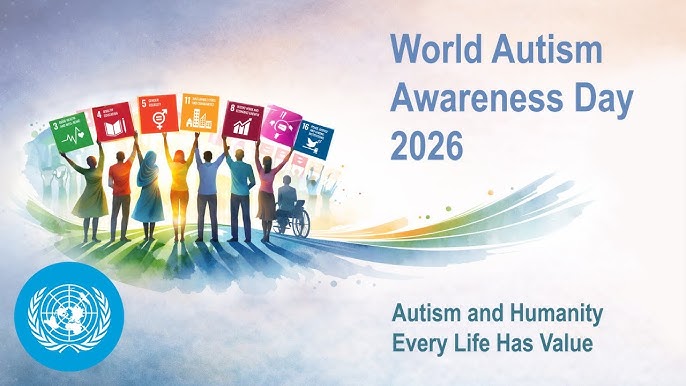
The United Nations theme for World Autism Awareness Day 2026 continues to emphasise a clear global direction: moving beyond awareness toward acceptance, inclusion, and empowerment of persons with autism across all stages of life.
At its core, the theme highlights three priorities:
– Inclusive education systems that accommodate neurodivergent learners
– Access to early diagnosis and intervention
– Meaningful participation in society, including employment and community life
Globally, the conversation has evolved. The question is no longer whether autistic individuals should be included, but how systems must adapt to ensure they are included with dignity and equity. Now place that against the reality in Nagaland. We are still struggling with awareness at the most basic level. Inclusion is inconsistent. Early diagnosis is limited. Therapy services are scarce and expensive. Employment pathways are almost non-existent. While global frameworks speak of empowerment, many families here are still fighting for admission into a classroom. While international policy discussions focus on independent living and workforce participation, many autistic individuals in our
state are yet to receive even foundational support. The gap is not subtle. It is structural, visible, and widening.
A Community of Parents fighting alone.
Across the state, parents have begun organizing; not out of choice, but necessity. Groups like Blessed Bonding, a parent-led network with over 150 members, exist to give voice to children who are often unheard. They provide support, share resources, and advocate for change. But the reality remains: families are carrying a burden that should never have been theirs alone.
Where Is the Government?
This is the question most parents ask quietly. Raising a child with autism involves continuous therapy: Speech, Occupational, Behavioural—along with medical consultations and specialised education. In Nagaland: Diagnostic services are limited, trained professionals are scarce, therapy centres are few, Government support is minimal. Many families travel outside the state, draining finances and energy. Others simply cannot afford to. Meanwhile, autism is not rare anymore. Globally, the World Health Organization estimates that 1 in 127 people are on the autism spectrum. In countries with stronger diagnostic systems, like the United States, the number among children is as high as 1 in 31.
In India, estimates suggest 1 in 65 to 1 in 100 children may be on the spectrum. Nagaland is not exempt from this reality. The only difference is—we have chosen not to measure it.
Autism does not end at childhood.
One of the most ignored truths: autistic children grow up. And when they do, many enter adulthood unprepared, not because they lack ability, but because the system never created pathways. No vocational training, no structured transition programs, no employment support. The result is predictable: dependency, isolation, and lost potential. This is not a family failure. This is systemic neglect.
What the world is learning.
Countries across the world are far from perfect, but they have recognised one thing: supporting people with autism is not charity- it is governance. They are investing in: Early diagnosis and intervention, Inclusive education with trained staff, Accessible therapy systems, vocational training and employment pathways. Nagaland does not need to replicate these systems overnight. But it must begin.
The cost families quietly carry.
Behind every autistic child is a family absorbing invisible costs. Therapy is expensive, travel is expensive, time is expensive, parents leave jobs, savings are drained, future become uncertain. And yet, most families do not complain publicly. They adapt, they endure. But endurance should not be mistaken for acceptance.
The Role of the Church: Influence without Inclusion.
In Nagaland, no institution shapes society more profoundly than the Church. It defines values, guides behaviour, and anchors community life. Its reach, trust, and moral authority exceed that of any government department. This makes this question unavoidable: Where are children with autism within this structure? Across the state, churches continue to grow in size, visibility, and resources.
Yet within these spaces, many neurodivergent children remain invisible.
Families consistently report the same realities: no trained Sunday school teachers, no adaptive learning environments, and behavioural differences that are misunderstood rather than supported. The result is not deliberate exclusion—but it is exclusion nonetheless. Quiet, systemic, and normalised. This is not just a gap. It is a missed responsibility.
When One Church Leads—and Others Look Away.
To be clear, the problem is not the absence of examples. It is the absence of replication. One church in Dimapur has already demonstrated what inclusion can look like in practice. It initiated inclusive worship specifically designed for children with intellectual and developmental disabilities and went further to establish an early intervention centre—an effort that directly supports both children and families. Recognising the need for wider change, this church took an additional step. A few years ago, it extended invitations to more than 100 churches across Dimapur to participate in its annual programme for children with IDD—an initiative aimed at sensitising and encouraging other congregations to follow suit. The response was telling. Only a handful of churches turned up.
That is the reality we must confront. The issue is not lack of awareness alone. It is lack of willingness to engage, to learn, and to act.
From Compassion to Structure.
Compassion, if it is to have meaning, must move beyond sentiment. It must be built into systems. Churches in Nagaland have both the capacity and the influence to initiate real change. This can begin with practical, measurable steps:
– Establish early intervention and support centres within church communities.
– Sponsor therapy services for families who cannot afford them.
– Train Sunday school teachers in inclusive and adaptive teaching methods.
– Engage special educators or trained volunteers to support neurodivergent children.
– Create structured, safe, and responsive environments for participation.
Sunday school, in particular, holds untapped potential. With the right design and support, it can become one of the most effective platforms for inclusion; where children with autism are not merely accommodated, but actively nurtured. At present, that potential remains largely unrealised.
What Inclusion Demands – Beyond the Church.
If Nagaland is serious about inclusion, then responsibility does not end with the Church. It extends to the entire system. And the requirements are not aspirational, they are foundational:
– Mandatory teacher training in autism and special education
– Functional inclusive education backed by trained personnel
– Early diagnosis and intervention services in government hospitals
– Accessible and affordable therapy services within the state
– Vocational training and employment pathways for autistic youth
– Public awareness that moves beyond symbolic observances into sustained education.
In a society that speaks so often of compassion, the real test is not what we say, but who we are willing to include. A Question we cannot avoid. Societies often measure progress through infrastructure, projects, and economic growth. But the real test lies elsewhere. How do we treat those who cannot compete on equal terms? Today, many families in Nagaland feel isolated, unheard, and unsupported. World Autism Awareness Day should not be another symbolic observance. It should be a moment of accountability. Because somewhere in
this state right now: A parent is being turned away from a school, a family is struggling to afford therapy, a child is growing up in a system that has not made space for them. So the question is not complex. It is brutally simple: Are autistic children part of our society? Or are they the children we have decided not to see?
“If families are struggling, schools are unprepared, the government is slow to act, and the Church remains on the sidelines, then the question is not where the problem lies—the question is who will take the first step toward change.”
A. Jimo
Treasurer, Blessed Bonding.